£1,995.00
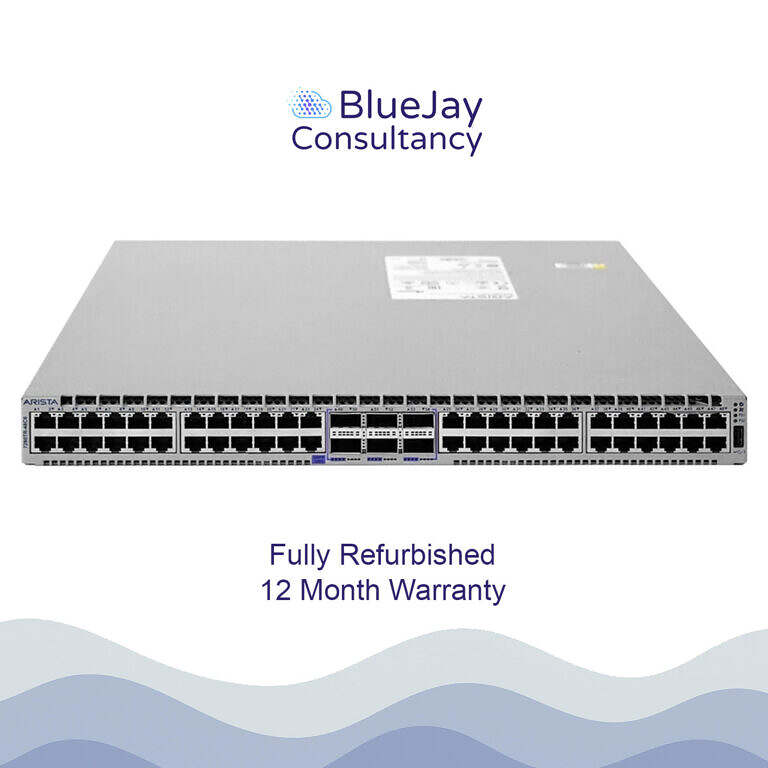
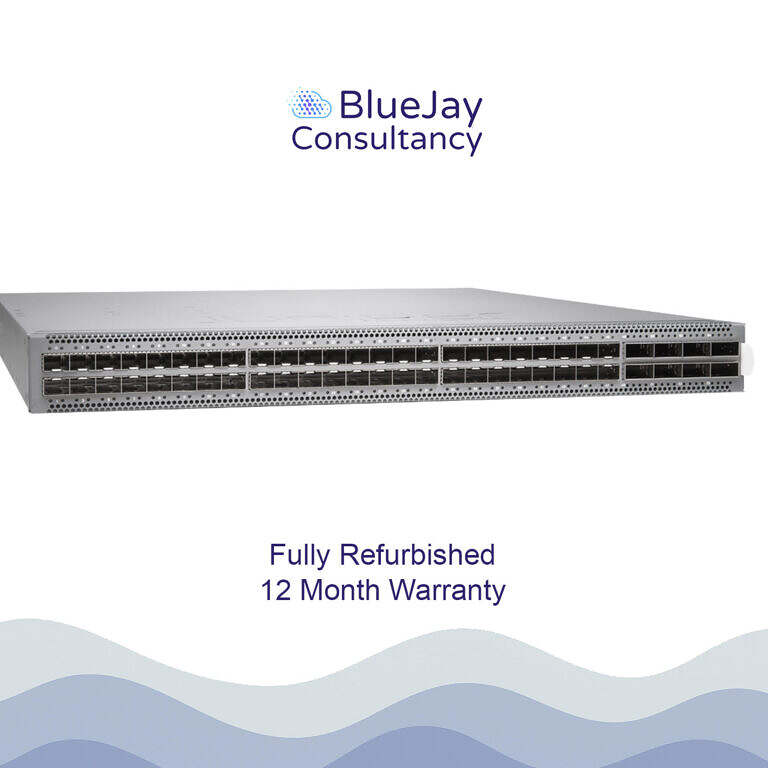
The Arista DCS-7170-64C is a high-performance, fixed-configuration data centre switch designed for scalable, programmable networking in cloud and enterprise environments. It offers a flexible combination of 100GbE, 50GbE, 25GbE, and 10GbE ports, making it suitable for both spine and leaf deployments.
Ports:
64 × 100GbE QSFP100 ports
2 × 10GbE SFP+ ports
Throughput: Up to 12.8 Tbps
Forwarding Rate: Up to 4.8 billion packets per second (Bpps)
Latency: As low as 800 nanoseconds
Packet Buffer: 22 MB shared across all ports
Form Factor: 2RU (rack units)
Airflow Options: Front-to-rear or rear-to-front
Power:
Dual hot-swappable power supplies (1+1 redundancy)
Typical power draw: 271 W; Maximum: 571 W
Cooling: Four N+1 hot-swappable fans
Management Ports: 1 × 10/100/1000 Ethernet, 1 × RS-232 serial (RJ-45), 1 × USB
Dimensions: 48.3 × 8.8 × 45.7 cm
Weight: 15.6 kg
Operating System: Arista EOS (Extensible Operating System)
Software Features:
Zero Touch Provisioning (ZTP)
Smart System Upgrade (SSU)
Hitless MLAG ISSU (In-Service Software Upgrade)
AlgoMatch for network policy
Advanced telemetry and monitoring with sFlow, IEEE 1588 Precision Timing, and VM Tracer integration
Large Scale NAT (Network Address Translation) support
128-way ECMP (Equal-Cost Multi-Path) and 64-way MLAG (Multi-Chassis Link Aggregation)
Programmable pipeline with P4 support for customised packet parsing and processing.
The DCS-7170-64C's QSFP100 ports can be configured in various modes:
100GbE: 64 ports
50GbE: 128 ports
25GbE: 256 ports
10GbE: 258 ports
This flexibility allows for efficient scaling and adaptation to evolving network requirements.
Built on Arista's programmable architecture, the DCS-7170-64C enables:
Dynamic Packet Parsing: Reconfigure packet headers and processing logic using P4 profiles.
Custom Table Sizes and Operations: Adjust forwarding tables and processing stages to meet specific application needs.
Flexible Resource Allocation: Customise L2 and L3 forwarding table resources for optimal performance.
Advanced Network Services: Offload network services such as tunnel termination and large-scale NAT from compute resources.
Enhanced Security: Implement stateful and hierarchical ACLs, rule-based policies, and conditional filtering for improved security.